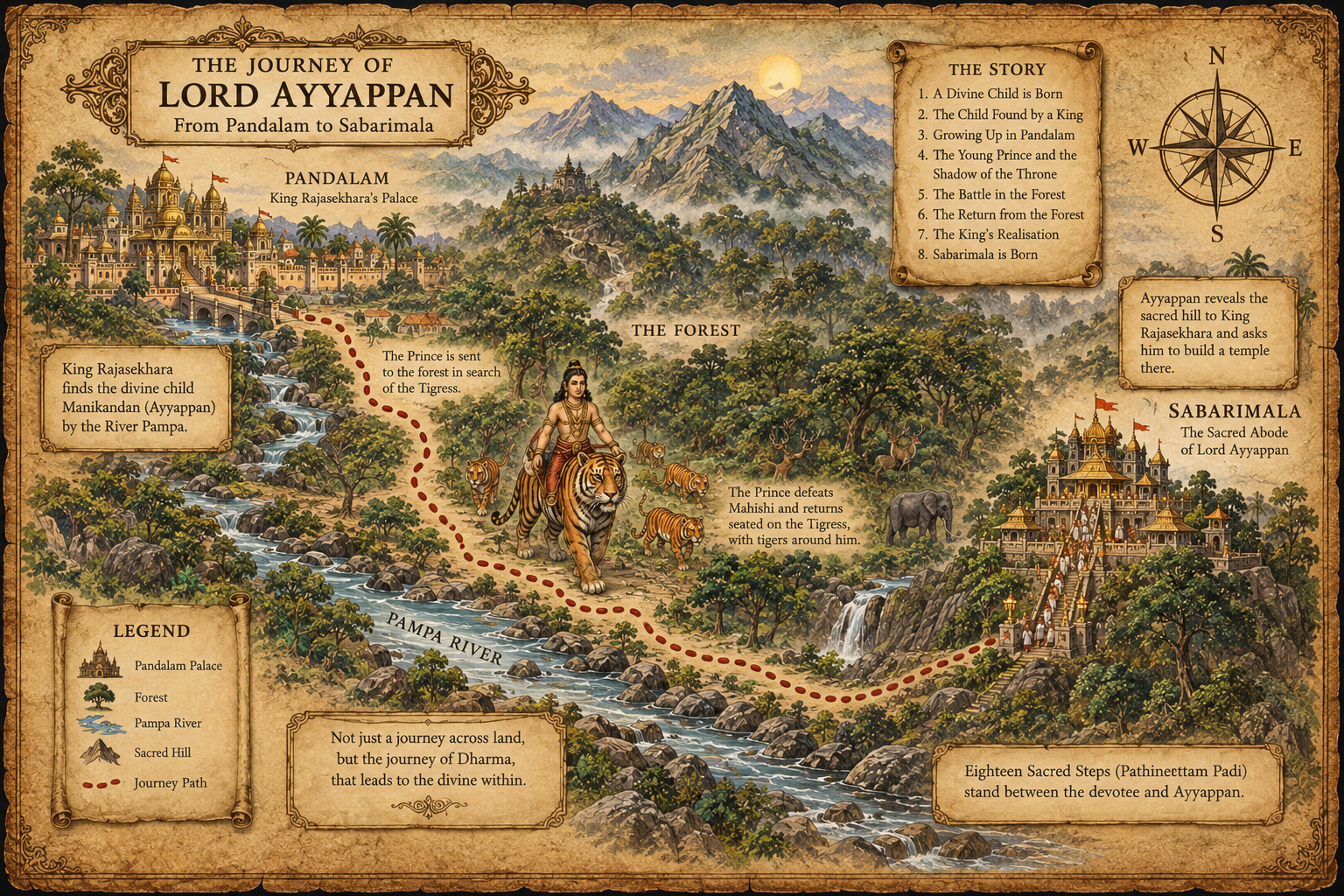
The Story of Lord Ayyappan
From a child found beside the Pampa to the Lord of the eighteen sacred steps.
The story of Lord Ayyappan is not merely the story of a god, a prince or a warrior. It is a story of destiny unfolding quietly through a child, of love that begins in a royal household, of courage tested in the darkness of a forest, and of a divine truth revealed in a moment so powerful that it has lived in the hearts of devotees for generations. It begins beside a river, passes through the palace of Pandalam and the wilderness of the forest, and finally rises into the sacred hills of Sabarimala. At every stage, the life of Ayyappan carries something deeply human within it: the longing for a child, the tenderness of adoption, the innocence of youth, the pain of betrayal, the courage to walk alone, the triumph of righteousness and, finally, the choice to leave worldly power behind in search of something eternal.
A Divine Child Is Born
According to Hindu tradition, the birth of Ayyappan was itself an extraordinary act of divine purpose. The world had come under the shadow of Mahishi, a fierce and powerful being who had received a boon that made her almost impossible to defeat. Protected by that boon, she believed herself beyond the reach of ordinary gods and men. Yet destiny had already taken shape. It was foretold that only a child born from Lord Shiva and Lord Vishnu, in the form of Mohini, could bring an end to her power. From this divine union came the child who would one day be known throughout the world as Lord Ayyappan.
But there was no palace waiting for him, no royal cradle prepared, no procession announcing his birth. His story began in stillness. The child appeared in the forests near the sacred River Pampa, surrounded not by courtiers but by trees, flowing water and the quiet mystery of nature. Around his neck rested a small bell, a mani, whose sound would give him the name by which he would first be known: Manikandan. It is one of the most beautiful images in the Ayyappan tradition — a divine child lying quietly in the wilderness, with no outward sign of the destiny that rested within him.
The Child Found by a King
At that time, King Rajasekhara of Pandalam carried within him a private sorrow. He and his Queen longed for a child, and despite the wealth and honour of the royal household, this absence weighed deeply upon them. One day, while travelling through the forests near the Pampa, the King heard the cry of an infant. Drawn towards the sound, he found a baby lying there alone, radiant and peaceful, with the small bell around his neck.
For the King, the moment must have felt almost beyond belief. Before him was not merely an abandoned child, but what appeared to be an answer to years of prayer. He lifted the baby into his arms and carried him back to the palace, not as a foundling but as a son. The Queen received him with the same tenderness. The boy was named Manikandan, and from that moment the palace that had once felt incomplete was filled with the presence of a child.
There is great tenderness in this part of the story. Before the world knew him as Ayyappan, he knew the affection of parents. Before he became the deity of Sabarimala, he was a little boy raised in a household that loved him. King Rajasekhara did not know the divine identity of the child he carried home. He simply loved him. In that love, one of the central themes of Ayyappan's story begins to emerge: the sacred often enters human life quietly, without announcement, and is recognised first not through miracles, but through love.
Growing Up in Pandalam
Manikandan grew within the royal household of Pandalam, surrounded by the responsibilities and expectations of a prince. Yet even in childhood, those around him began to see qualities that set him apart. He was extraordinarily intelligent and absorbed knowledge with ease. He studied the scriptures, learned the arts of governance and trained in the martial disciplines expected of a future ruler. Yet his strength was never separated from compassion, nor his intelligence from humility.
He was courageous, but not reckless. He was confident, but not proud. He seemed to possess the unusual ability to understand suffering in others and to respond to it with gentleness. His teachers saw in him a student of rare ability; the people saw in him a young prince who seemed naturally close to them. He did not rely on royal status to command affection. His presence itself inspired trust.
To King Rajasekhara, however, Manikandan was first and foremost his son. The King watched him grow with the pride of a father who had once believed he might never experience such joy. Over the years, the bond between them deepened. The King could not have known that the boy walking beside him through the palace halls carried within him a destiny that would one day take him away from everything they had built together.
The Young Prince and the Shadow of the Throne
As Manikandan entered adolescence, the serenity of his childhood began to give way to the complicated world of the palace. The Queen later gave birth to a son of her own, and what should have been another moment of joy gradually became entangled with anxiety about succession. Manikandan, as the elder prince, was naturally seen as the heir to the throne. Around the royal household, fears began to grow that the Queen's biological son might never become King.
According to the traditional story, those fears were manipulated by people within the palace who wished to see Manikandan removed. A plan was formed, subtle at first and then cruel in its intention. The Queen pretended to fall gravely ill. The royal physician declared that she could be cured only by drinking the milk of a tigress.
Everyone understood what such a request meant. To enter the forest, find a tigress, take her milk and return alive was not a mission; it was almost certainly a death sentence. The expectation was that no prince, however brave, could survive it.
When Manikandan heard of his mother's supposed illness and the cure that had been prescribed, he did not rage, accuse or hesitate. He simply offered to go.
One can imagine the pain of King Rajasekhara in that moment. The son he loved was preparing to walk into a forest from which he might never return. Yet Manikandan remained composed. There was no fear in him, only purpose. The palace had unknowingly brought him to the threshold of the destiny for which he had been born.
And so the young prince left Pandalam and walked alone towards the forest.
The Battle in the Forest
The forest into which Manikandan entered was more than a place of physical danger. In the Ayyappan tradition, it is where the ordinary life of the prince gives way to the revelation of the divine. Away from the palace, away from the protection of his father and far from everything familiar, Manikandan came face to face with Mahishi.
She was the force whose existence had shaped the very purpose of his birth. For years, her power had seemed unassailable. The boon that protected her had created the certainty that no ordinary opponent could defeat her. Yet standing before her now was the one being whose birth had fulfilled the impossible condition of that boon.
What followed was a battle not merely of strength, but of destiny. The prince of Pandalam revealed the divine power that had always rested within him. The child found beside the Pampa, the boy raised with affection in a royal household, the young man who had walked alone into the wilderness — all of these identities converged in that moment.
Mahishi was defeated.
The purpose for which Ayyappan had descended into the world had been fulfilled.
Yet the people of Pandalam knew nothing of this. The palace remained behind him, filled with uncertainty. King Rajasekhara waited for his son. The Queen waited. The people waited. Perhaps with each passing day, hope grew thinner.
Then, from the direction of the forest, something began to stir.
The Return from the Forest
There are moments in sacred stories that remain alive because they transcend explanation. The return of Manikandan from the forest is one of those moments.
Word began to travel towards Pandalam that something extraordinary was approaching. People came out of their homes. The palace stirred. Eyes turned towards the road leading from the forest.
At first, perhaps, they heard it before they fully understood what they were seeing: the movement of animals, the low sounds of the forest drawing closer, the growing murmur of a crowd unable to comprehend the sight before them.
Then Manikandan appeared.
He was not returning exhausted, wounded or defeated. He was not carrying a vessel of milk in his hands. He was seated calmly upon the back of a great tigress.
And around her moved the tigers.
They emerged from the forest like a living royal procession. Powerful animals that would ordinarily inspire terror walked in perfect submission around the young prince. Tigers flanked the tigress on either side, others followed behind, their great bodies moving with an almost ceremonial majesty. The forest itself seemed to be escorting Manikandan home.
At the centre of that astonishing procession sat the boy who had left Pandalam alone.
There was no fear in him. No triumphal arrogance. No anger towards those who had sent him away. He sat with extraordinary stillness, as though the impossible sight surrounding him were the most natural thing in the world.
Imagine the palace in that moment. The Queen who had asked for a tigress's milk now saw not merely the milk she had demanded, but the tigress herself approaching the gates. The plot that had been designed to destroy Manikandan returned transformed into the very revelation of who he truly was.
The tigers did not attack. They did not roar against the people. They moved beside him.
To one side, a tiger. To the other, another. Behind them, more emerged from the edge of the forest. At their centre rode Manikandan, serene and radiant.
It was no longer possible to see him simply as the adopted prince of Pandalam.
The truth stood before them.
King Rajasekhara looked upon the son he had carried home as an infant, the child he had raised and loved, and understood that the divine had lived beneath his roof all those years.
Manikandan was Ayyappan.
The King did not gain a son and later discover a god.
He discovered that the son he had loved had always been divine.
The King’s Realisation
For King Rajasekhara, the revelation carried both wonder and heartbreak. The child whom he had held in his arms beside the Pampa, whom he had watched grow through the years, could no longer be thought of only as the heir to Pandalam. Ayyappan's destiny belonged to something infinitely greater than the throne.
The King is said to have fallen before him, overwhelmed by emotion and remorse for everything that had happened. Yet Ayyappan showed no bitterness. There was no anger towards the Queen, no desire for retribution against those who had plotted against him, no triumph in having proved them wrong. The journey into the forest had not changed Manikandan. It had simply revealed who he had always been.
For Rajasekhara, this must have been a moment of almost unbearable tenderness. He had once found a helpless infant beside a river and carried him home believing that the gods had answered his prayer for a child. He had watched that child grow, had loved him as his own, had imagined a future for him within Pandalam. Now, standing before Ayyappan, the King understood that the blessing entrusted to him had never been his to keep.
The prince could have returned to the palace and claimed the throne. No one could now have questioned his right to rule. Yet Ayyappan had no desire for kingship. The palace, the crown and the kingdom belonged to the world he was preparing to leave behind.
Rajasekhara asked what he could do for him. If Ayyappan would not remain as his son and King, then let there at least be a place upon this earth where his presence would remain; a place where the King could bow before him, and where generations yet unborn might one day come in search of him.
Ayyappan answered his father's prayer.
And from that moment, the story of Sabarimala began.
Sabarimala Is Born
Ayyappan directed King Rajasekhara towards the great forested hills beyond the Pampa and revealed the sacred place where his shrine was to stand. Tradition speaks of Ayyappan indicating the spot upon Sabarimala where the King should establish the temple. It was not in the centre of a city, nor beside the splendour of a royal road. It lay deep within the mountains, wrapped in forest, silence and wilderness.
There was something profoundly fitting about the place.
Ayyappan had first entered Rajasekhara's life from the forest. It was into the forest that he had later walked alone when sent in search of the tigress. It was from the forest that he had returned in his divine splendour, seated upon the tigress and surrounded by tigers. And now it was within those same ancient hills that he chose to remain.
King Rajasekhara returned to Pandalam carrying a duty unlike any he had known as a ruler. This was no palace to display the wealth of his kingdom and no monument to preserve his own name. He was building a home for the divine son he had once held in his arms.
The route into the hills was difficult. The forests were dense and the land remote. Yet the King followed Ayyappan's instruction and established the sacred shrine at Sabarimala. Tradition holds that the great sage Parasurama consecrated the image of Lord Ayyappan there, establishing him in the form in which devotees would come to worship him through the generations.
There Ayyappan sat, no longer the young prince of Pandalam, but as Dharma Sastha — serene, powerful and utterly still.
The warrior who had defeated Mahishi now appeared as the yogi who had conquered himself.
The prince who could have inherited a throne chose instead a seat among the mountains.
The child who had once belonged to one father and one mother now belonged to everyone who would call upon him.
For Rajasekhara, perhaps this was the final act of fatherhood: not holding on to his son, but creating the place from which the world could find him.
And slowly, something extraordinary began.
People came.
At first they came through the forests and across the hills. Then others followed. Stories travelled from family to family and from generation to generation. Men left their homes carrying vows and prayers. They walked the paths that led towards the sacred hill. They crossed the Pampa. They called one another Swami. They climbed towards the shrine with Ayyappan's name upon their lips.
A temple had been built upon a mountain.
But Sabarimala became much more than a temple.
It became a journey.
And at the end of that journey, between the devotee and Ayyappan, stood eighteen sacred steps.
The Journey of Lord Ayyappan
From Pandalam to Sabarimala